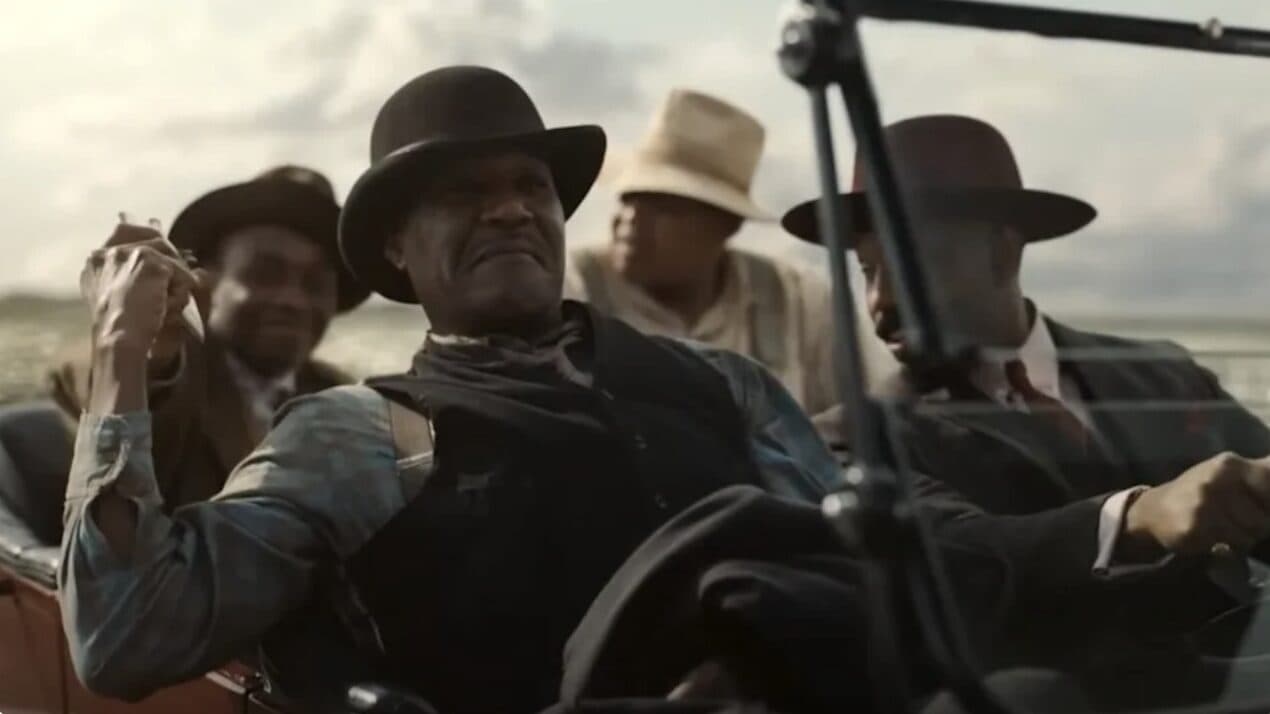
There is a pivotal scene in the film Sinners that lays bare an unfathomable crime. Early on, we meet Delta Slim—a masterful blues player and a drunk who, despite his outward joviality, appears both haunted and hunted. It quickly becomes clear what has shaped the complex inner life of this towering man, who seems to want nothing more than to disappear into a haze of smoke and the melodies that so effortlessly pour from his soul.
As Sammie, Stack, Cornbread and Delta Slim pass a chain gang—a common sight in the Jim Crow South—Delta raises his hand and voice to call out encouragement to the men, many of whom share his past. He too was once imprisoned under similar conditions, alongside a friend who had recently come into good fortune. Delta recounts how that friend was accosted by a group of white men—driven by hate, envy, or the monstrous thrill of extinguishing a Black life. They accused him of theft and, without hesitation, beat, flayed, and desecrated his body. Standing before the vast cotton fields, Delta’s gaze drifts into the distance.
“You know they cut off his manhood,” he murmurs darkly.
The words are followed by a series of groans, as though he is trying—and failing—to swallow his anguish. Unable to contain it, he releases it the only way he can: through music. Stack instructs Sammie to join him on guitar, and what unfolds is a powerful expression of the origins of the blues.
In a time when Black expression was policed—frowned upon at best, fatal at worst—the blues became a coded language. It is collective memory made audible. It is an articulation of survival in the face of the unspeakable. Hope, despair, grief, and reverence coexist within it. It is a uniquely Black art form, born from uniquely brutal circumstances. Through the blues and later jazz, Black people reclaimed dignity and asserted humanity—not for the benefit of our oppressors, but as a necessary reminder to ourselves that we are somebody, as Jesse Jackson so simply put it.
The blues was born of restraint. And while the exact conditions that birthed it may have shifted, the disrespect and disregard for Black life have not.
We saw this on display during the 2026 awards season at the BAFTAs in the UK. As Delroy Lindo and Michael B. Jordan stood preparing to present the evening’s first award, John Davidson shouted the word “n*gger” (hard “r”) in their direction. Reports suggest this was not the first time he had used the slur that evening, having directed it at at least two other Black attendees. In the clip—one the BBC chose to air despite a broadcast delay—you see the two men freeze, stunned into silence.
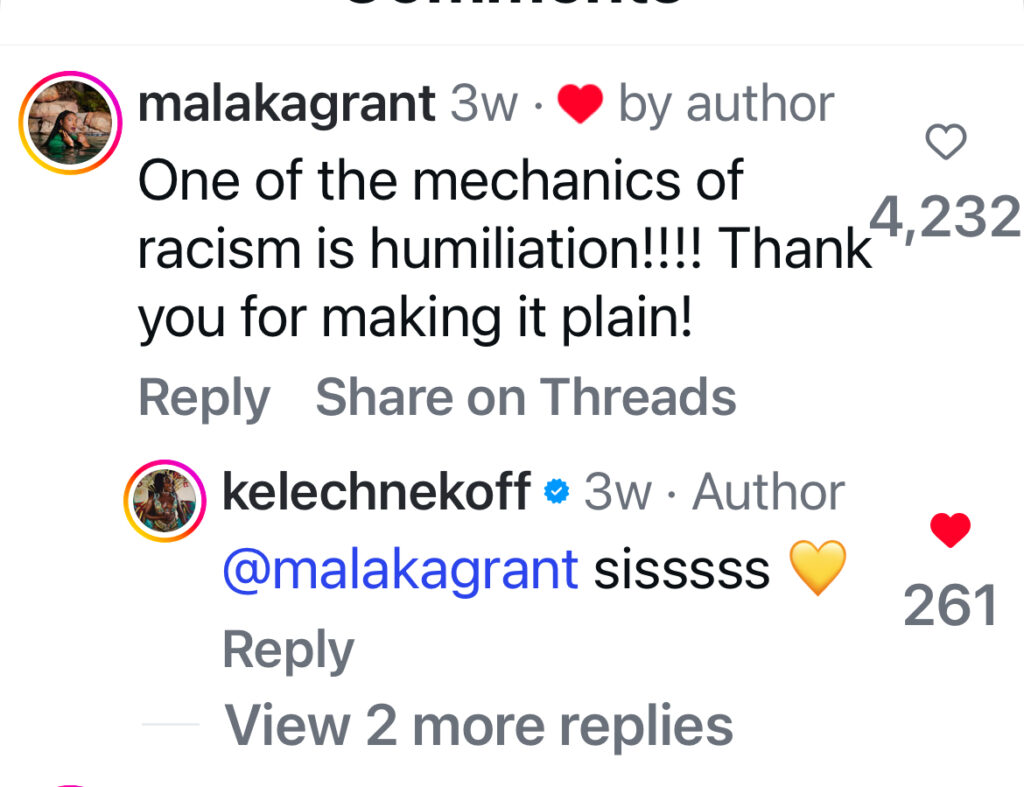
Their reaction echoed Delta Slim’s story: the paralysis of shock, the weight of humiliation, the demand—spoken or unspoken—to endure. And then, the pivot to labor. Like Delta, Lindo was there to do a job. Despite the assault on his humanity, delivered on a global stage, he carried on with professionalism and grace. But the damage was done. Intentional or not, one of the mechanics of racism is humiliation, as author and activist Kelechi Okafor explains in this Reel.
The aftermath was as predictable as it was telling. Calls emerged—primarily from white audiences—urging Black people to show more “grace” and to avoid ableist rhetoric. After all, Davidson cannot control his tics. In one interview, a white British man living with Tourette’s suggested that the conversation was unfairly pitting the “disabled community against the Black community.” The statement was striking in its omission—as though Black people do not also live with disabilities, as though our identities can be neatly separated, as though our pain is ever singular.
Even within marginalized groups, Blackness is often rendered invisible, or at best, an afterthought.
What we are left with, then, is a familiar inheritance: the expectation that we absorb harm quietly, process it privately, and continue performing publicly. But the lesson of the blues—and of Delta Slim—is not silence. It is transformation. It is the radical act of refusing to let pain remain inert. For generations, Black creatives have taken what was meant to break them and made something enduring, something beautiful, something undeniable. Not because suffering is noble, but because survival demands expression. And yet, we must ask ourselves: at what cost? If our art continues to be born from wounds inflicted by a world that refuses to see us fully, then perhaps the true evolution is not just in what we create, but in what we refuse to endure.